
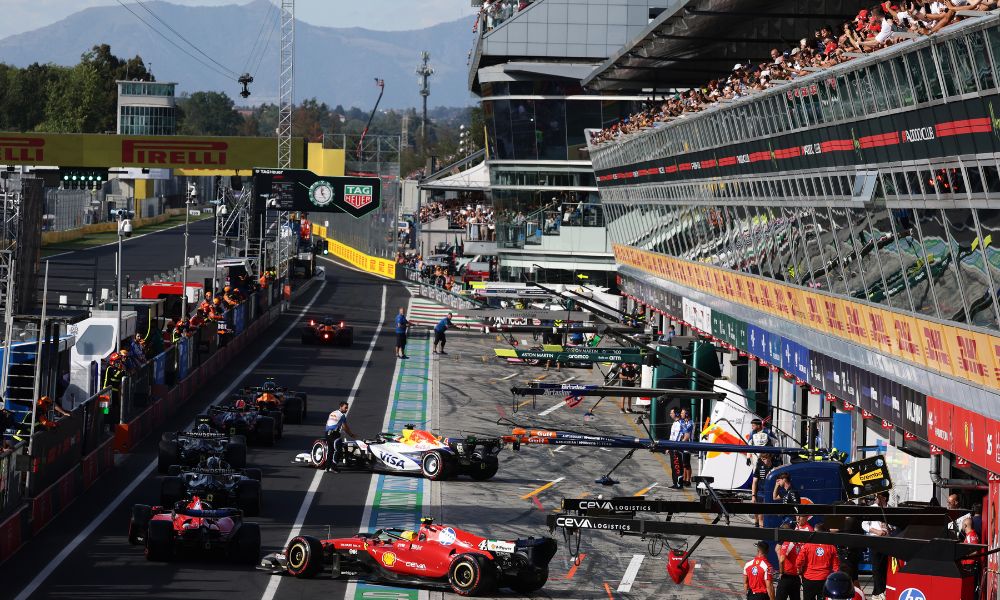
Formula One sponsorship is growing quickly. But the most interesting change is not simply the amount of money coming into the sport, it is what brands now expect that investment to deliver.
SponsorUnited estimates that Formula One team sponsorship revenue reached US$2.54 billion in 2025. For 2026, Ampere Analysis expects total sponsorship investment across Formula One and its teams to pass US$3 billion.
For a long time, sponsorship was discussed mainly in terms of visibility: logo placement, broadcast exposure, audience reach and media value. Those things still matter but, increasingly, the conversation starts somewhere else: what are we actually trying to achieve?
SponsorUnited estimates that technology alone accounted for US$769 million of Formula One team sponsorship spend in 2025. For companies selling technology, capital, infrastructure or expertise, the value of Formula One can look very different.
From audience to ecosystem
Carlyle’s partnership with the Red Bull Formula One team offers a great case study in why a brand gets involved in the sport.
The global private markets firm became Red Bull’s exclusive investment management partner in 2025. Bloomberg reported in April 2026 that clients who attended Formula One events through Carlyle were preparing to allocate capital to the firm’s funds, including one allocation worth nine figures.
For some B2B brands, sponsorship value cannot be understood through media exposure alone. Formula One can create repeated access to clients, investors and senior decision-makers across a global calendar.
A Formula One team is now more than a media property – around it sits a high-value business ecosystem of partners, suppliers, customers, investors and institutions where relationships can develop over time.
The logo still matters. But increasingly, the logo is the visible layer of a much deeper commercial strategy.
If brands can connect that access to real business outcomes, the quality of the ecosystem a team can bring together could become increasingly important alongside audience, performance and rights.
B2C is entering another growth cycle
It would be wrong to assume that this means Formula One is becoming purely a B2B environment.
Formula One has already built a powerful consumer business at championship level through licensing, merchandise and global partnerships. In the first half of 2026 alone, the sport announced 20 new consumer-product licensing partners. What is interesting is how that momentum is also now reaching the teams.
M&S’s multi-year partnership with Williams is a good example. As the official travel kit partner, the retailer is using the relationship to build its international profile, create consumer-facing content and engage fans.
Alongside this deal, M&S has built a wider presence around the British Grand Prix through its partnership with Silverstone, including the first fashion show staged in the circuit’s pit lane.
Consumer brands do not necessarily need title-level rights to create value. Official partnerships, supply relationships, product collaborations and licensing all offer different ways into the sport and its fanbase.
For a B2B company, the target might be customers, investors or senior decision-makers. For a consumer brand, it might be fans, communities or new customers.
The principle is the same: understand who you are trying to reach before deciding where to buy.
Start with who you need to reach
Once the objective is clear, the next question is where those people actually are.
Different championships bring together different industries, audiences and business communities. Formula One combines global consumer reach with a highly international business ecosystem. Endurance racing has deep links with automotive, engineering and industry. Formula E has built a distinctive network around technology, electrification and sustainability.
There is plenty of overlap, but having the largest audience does not necessarily mean having the right audience. The best property is the one with the strongest overlap between what the brand wants to achieve and the people it needs to reach.
Once the series has been selected, the same logic applies to the team, driver or property, as well as to the level of rights. A title partnership may make sense when scale, visibility and association are central. In other cases, an official partnership, technology relationship or targeted activation may achieve the objective more efficiently.
At AxeOne, that is how we increasingly approach the question – start with the objective, then work through the markets, audiences, property, rights and activation required to deliver it.
Do not let the inventory define the strategy
The problem is that sponsorship decisions often start at the other end of that process. In short, an organisation only begins to consider the business case once a property becomes available and a rights package is pitched.
By that point, the inventory is driving the strategy rather than the strategy determining the inventory.
Formula One might be the answer, but that won’t always be the case. Even when it is, the most visible team or largest rights package may not be the right solution.
A consumer business looking for international awareness should not assess motorsport like an enterprise technology company seeking prospective customers, product validation and senior-level access.
The property, and the rights attached to it, should follow the objective.
Measure what you actually bought
The same principle applies to measurement.
If awareness is the objective, then reach, engagement and media value are relevant. If the objective is B2B growth, better indicators might be qualified meetings, opportunities created, pipeline influenced and eventual conversion.
For a technology partner, success may mean deployment, product validation or a credible case study. For hospitality, it may be less about how many guests attended and more about who was in the room and whether important relationships moved forward.
These outcomes are not always immediate, and B2B attribution is rarely perfect. But at least they measure the reason the investment was made.
As motorsport attracts more investment, brands will have more ways into the sport than ever. The challenge will not simply be deciding where to spend, it will be understanding what that investment is supposed to unlock.
The property is not the strategy, the business objective comes first.
For more motorsport partnership insights from AxeOne, click here.