

“Firstly, a big congratulations to Max and to his team.”
Lewis Hamilton’s first words in the wake of one of the most controversial moments in sporting history perfectly encapsulated the mettle of a man accustomed to overcoming obstacles.
Honesty and authenticity are key contributors to a modern athlete’s marketability, and nowhere are these traits developed more deeply than in the face of adversity.
Hamilton was denied a record-breaking eighth Formula One world title towards the end of the 2021 Abu Dhabi Grand Prix by an unprecedented decision from race director Michael Masi to disregard the written regulations around safety car restarts, which ultimately saw season-long rival Max Verstappen emerge victorious on the final lap.
It seems odd that one of the most defining moments of a Formula One career that contains seven world championships will be one that he did not win. This is, after all, Formula One’s most successful driver of all time. But athletes are so often judged on their successes, especially today, when ‘GOAT’ discussions seemingly take precedence over nuanced debate, that it’s easy to overlook their behaviour in defeat.
Much has been said about Hamilton’s working-class upbringing on a council estate in Stevenage – his father had to work multiple jobs to fund his junior career before he was picked up by Mercedes and McLaren at 13 years old.
Hamilton is also the first and only Black driver to compete in Formula One, which is a statistic that does not look like changing for some time. This made Hamilton an isolated figure within Formula One, particularly during his early years, and shaped how he has grown into the social advocate he is today.
It could be argued that few figures in the world of sport have experienced a journey like Hamilton’s – a path that has made him a uniquely authentic, influential and marketable individual.
It is therefore no surprise that he has been named as the world’s most marketable athlete in 2025, becoming only the fourth sportsperson to top SportsPro’s annual ranking for the second time in his career.
‘A phenomenon of British motorsport’
It’s impossible to assess Hamilton’s marketability without first acknowledging his rise since entering Formula One as a fresh-faced 22-year-old.
Any questions around his on-track talent were unequivocally answered with one of the best rookie seasons in the sport’s history, which was quickly followed by his first world title in his sophomore year.
As former McLaren Racing communications director Matt Bishop tells BlackBook Motorsport, it was obvious from those early days that Hamilton was going to become “an absolute phenomenon of British motorsport”.
Bishop joined the team at the start of that title-winning season in 2008 and remembers a driver who was “quite brilliant, but nervily so”, likely influenced by his position as the only Black driver in the sport. His position was under increased scrutiny as a result, while he also had a tumultuous relationship with former McLaren boss Ron Dennis.
This all contributed to Hamilton’s considerable emotional growth over the years. After all, as Bishop recalls, “he wasn’t a particularly mature 22” when he joined the sport.
For instance, in 2012, the then-27-year-old took to Twitter to complain about discrepancies between his and teammate Jenson Button’s cars after being left disappointed with a qualifying result for the Belgian Grand Prix, inadvertently revealing sensitive data about the McLaren cars. The post had to swiftly be deleted after some convincing from Bishop, who has written about the entire episode.
Comparing that reaction to a relatively minor event with how Hamilton handled himself in the wake of the 2021 Abu Dhabi Grand Prix demonstrates his personal growth over the years. For Bishop, who was in the paddock that day working for the Aston Martin team, it is the perfect illustration of a man who has come to recognise that his impact goes far beyond the world of Formula One.
“I remember seeing Lewis drive into parc ferme and then sitting silently for quite a time,” he says. “A man in extremis in the public eye with hundreds of millions of people watching – we don’t have that kind of pressure, very few people do.
“He knew he’d been wronged, and he knew that only he, without assistance, was going to have to work out how to be. When he took his helmet off, he must have decided on his own to be quiet and dignified and sportsmanlike.
“I can’t tell you how impressive I thought that was – and it was entirely authentic. He found that strength of character within the coils of his condition, which was surely a mixture of anger and disappointment and outrage, but he still managed to find that equilibrium.
“I don’t think many people in the world could do that.”
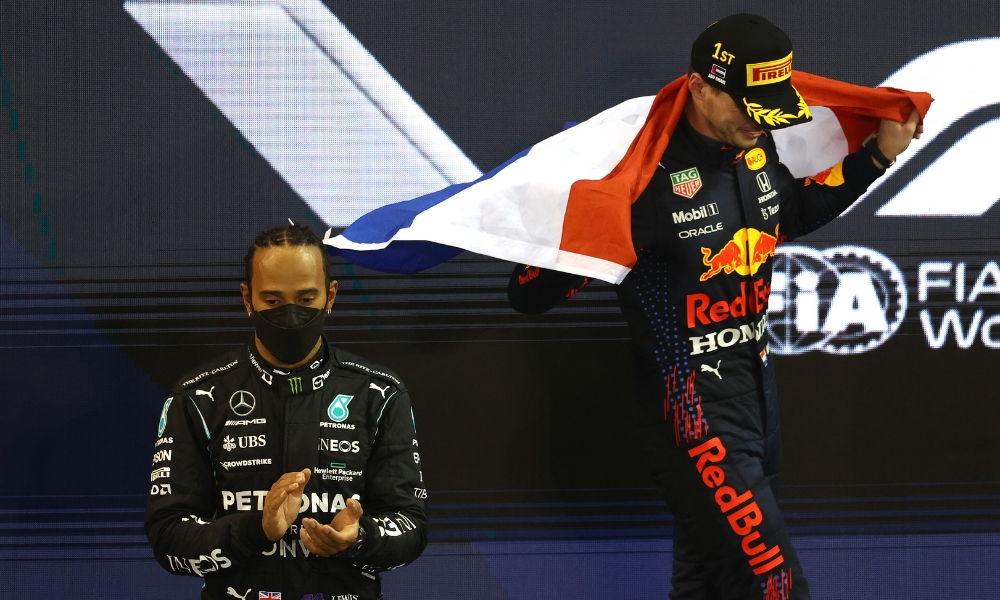
Hamilton was dignified in defeat despite the highly contentious final lap at the 2021 Abu Dhabi Grand Prix, remaining on the podium for the duration of Verstappen’s title celebrations (Image credit: Getty Images)
‘An inspiration to millions around the world’
Now 40 years old, Hamilton is the oldest athlete to ever top SportsPro’s 50 Most Marketable (50MM) ranking. Yet even as his on-track powers have started to wane, Hamilton has still found new ways to stay relevant towards the end of his career.
While his switch from Mercedes to Ferrari hasn’t quite worked out in the way Hamilton might have hoped, it was viewed a commercial masterstroke that generated significant buzz and created new storytelling opportunities around an athlete who had already won multiple titles and broken numerous records.
But perhaps Hamilton’s greatest recent achievement from a marketability standpoint is how he has established himself as an entirely relatable individual. Staying truly authentic in the age of social media can be a challenge, but his ability to be unapologetically himself has enabled him to cut-through in a way that few others can.
The outpouring of support that Hamilton received following the loss of his much-loved dog Roscoe in October was testament to the strength of the relationship he has built with his fans, be it through his success in Formula One, his moves into fashion and entertainment or the various causes he has stood up for throughout his career.
That can also be seen in Hamilton’s performance across NorthStar Solutions Group’s athlete marketability model, which ranked him highest of all sportsmen for authenticity and top among all athletes for purpose, mission and values.
Hamilton’s growing activity away from the track has not only ensured he remains a culturally relevant figure, but it has also helped to diversify his audience beyond the core motorsport fanbase, strengthening his marketability and sustaining his appeal among brands.
Indeed, Hamilton has secured a number of new endorsement deals this year, adding to his most prominent and long-standing collaboration with Tommy Hilfiger. A deal agreed with Perplexity, a search engine powered by artificial intelligence (AI) valued at US$9 billion, emphasised Hamilton’s commercial pull, as the company opted for an endorsement deal with him over partnering with a Formula One team.
Perhaps most notably, Lululemon made its biggest move in motorsport by naming Hamilton as its first global ambassador from the world of Formula One, further cementing his ties with the world of fashion. The Canadian-headquartered company has historically been associated with women’s athletic apparel, but wants Hamilton at the forefront of promoting its menswear range.
“Lewis embodies everything we look for in our ambassador partnerships – he’s a mindful athlete who leads with intention, purpose, and authenticity,” Nikki Neuburger, chief brand and product activation officer at Lululemon, tells SportsPro.
“He’s also an inspiration to millions of people all around the world – not just through his extraordinary achievements on the track, but through his individuality and distinctive style, and above all, the way he shows up with compassion and a deep sense of care for others.”
Eliminating barriers to entry
Lululemon choosing Hamilton also isn’t just for his huge reach and resonance. As a champion of the Black Lives Matter movement and someone who continues to push for greater diversity in motorsport, aligning with Hamilton and his values will enable the company to distance itself from previous controversies.
“From the beginning, our partnership has been grounded in our shared values of community and connection,” reveals Neuburger. “Lewis is deeply committed to creating positive change through his foundation, Mission 44, which we’re proud to support through our ‘Lululemon Gives’ initiative.”
This initiative will see the athleisure brand work with the seven-time world champion’s charity to integrate movement and mental health experiences into their efforts to build a fairer future for young people.
This underlines another core pillar of Hamilton’s mission. Mission 44 is working to create greater representation, diversity and inclusion in the STEM and motorsport industries by delivering education, empowerment and employment opportunities. The charity already works with Ferrari title sponsor HP and partner IBM, and it teamed up with Formula One itself last year, highlighting the wider impact that Hamilton is having beyond the sport.
Just last weekend at the United States Grand Prix, Hamilton and Mission 44 pledged US$2 million to STEM organisations with the aim of setting up 6,000 young people for careers in STEM over the next three years.
This isn’t work that Hamilton needs to be doing yet he does it regardless, supporting those less fortunate in an effort to remove some of the barriers he encountered on his own journey to the top. He is also visibly supportive of the all-female F1 Academy series, cementing his status as a vocal advocate for gender equality.
Any accusation of virtue signalling can be firmly dismissed, too. An outspoken environmentalist and former PETA person of the year, Hamilton is also one of the most high-profile global athletes to have advocated for peace in Gaza, a topic that many have chosen to avoid.
All of this combines to create a bona fide multi-hyphenate unlike any other in wider sport right now. Will a Formula One driver ever be asked to co-chair the Met Gala again? It’s unlikely.
Float like a butterfly, sting like a bee
What’s left to achieve for someone that’s won it all in Formula One? That eighth world championship remains elusive but transcending the sport means that Hamilton is now defined by much more than his on-track success.
Whenever retirement arrives, Hamilton will leave Formula One in a much better place than he found it thanks to his tireless work and advocacy, which will see him continue to make an impact after he steps away from racing.
In many ways, Formula One needs Hamilton much more than the other way around. Look at what happened to MotoGP after Valentino Rossi stepped away for a comparable scenario. While the adverse effects may not be as obvious in Formula One due to its wider popularity, there are no drivers capable of filling the Hamilton-sized hole on the grid – and there won’t be for some time.
Verstappen is already one of the all-time greats but clearly doesn’t have the same affection for the publicity that comes with racing success. Charles Leclerc is the most marketable motorsport driver not named Lewis Hamilton in this year’s 50MM but doesn’t yet have the on-track success to go with it. The likes of Lando Norris, Oscar Piastri and George Russell are also still building their marketability.
Thanks to his unimaginably large social media audience and fledgling business interests inside and outside of motorsport, Hamilton will become one of the rare athletes that continues to command sizeable attention in retirement. It will be interesting to see how he continues to use his platform as a force for good.
Bishop sees this building into something truly impactful in the political world, something akin to the career path of another Black icon who became so much more than their sport.
“Now I don’t see [Hamilton] becoming prime minister of the United Kingdom,” he begins. “But I do see him thinking carefully about what causes he might embrace and champion, and becoming a little bit like someone else who didn’t become president of the United States of America but did continue to exert a positive influence: Muhammad Ali.”
Indeed, Ali has been a big inspiration for much of Hamilton’s career. He has a tattoo dedicated to his icon and has spoken of looking up to the boxer over Formula One drivers when he was younger. After Ali’s death, Hamilton paid tribute to him with the famous floating, stinging catchphrase after winning the 2016 Canadian Grand Prix.
Now, Hamilton is being backed to follow a similar path to his idol.
“I could see him living that kind of life in retirement and I’m fascinated to watch him,” Bishop adds.
